Service
Ceiling Fan Installation, Replacement and Fan-Rated Boxes
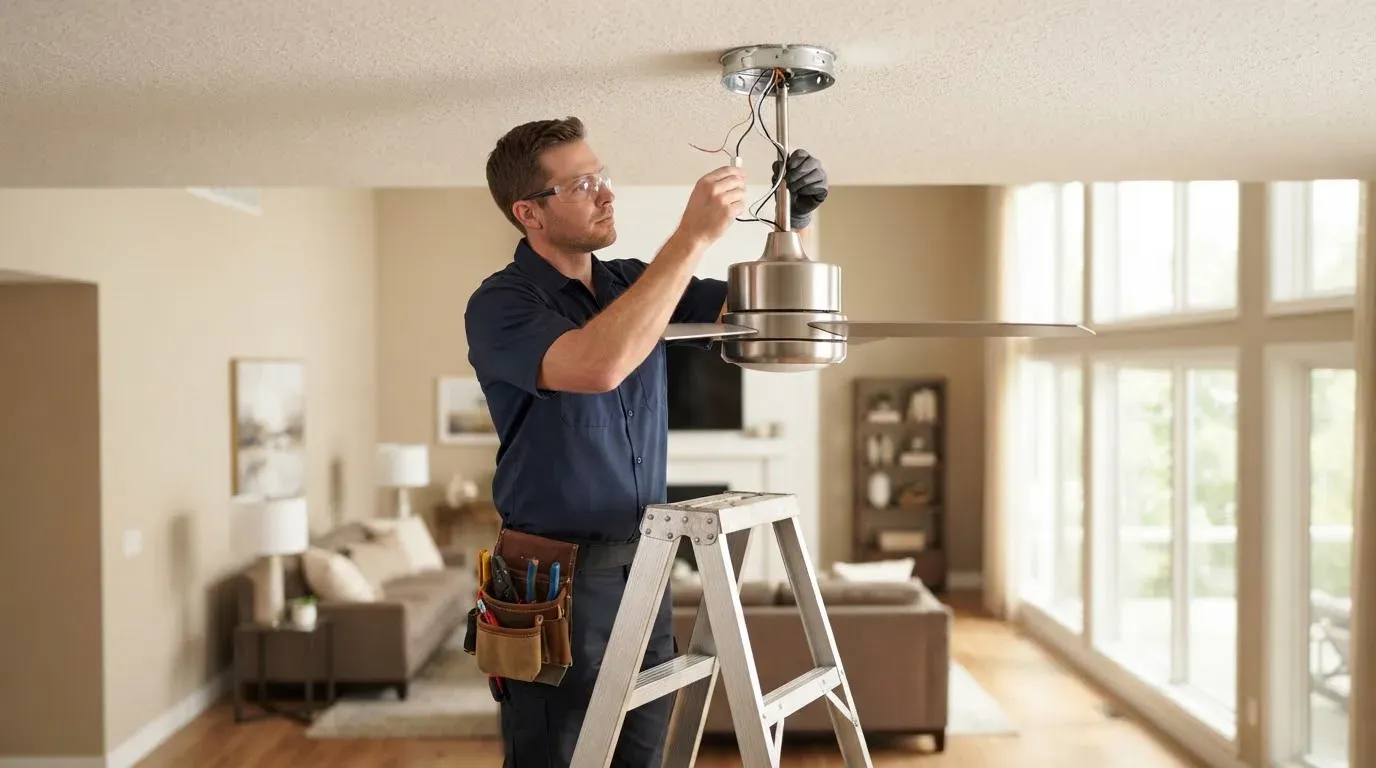
Swapping a light for a fan, or adding one where there's none? A licensed electrician mounts it on a rated box, so it runs steady and stays put.
Start with a call
Tell us what's going on and where the job is. We'll get a licensed electrician out, and you'll know the price before the job begins.
What’s the hardest part of installing a ceiling fan?
Supporting it. The wiring on a ceiling fan installation is usually simple; holding a spinning, shaking weight over people’s heads for years is not. Call Hire Local Electrician with the room, the ceiling height and what’s up there now, and we’ll get a licensed electrician out to hang the fan on a box built for it.
Fan-rated boxes are braced straight to the framing and marked for fan support. Under the National Electrical Code, a box can be the sole support for a fan up to 70 pounds only if it’s listed and marked for that use. A standard light box isn’t, and a fan hung from one is a real risk. If the fan is replacing a light, expect the box to be replaced too, and if the ceiling has to be opened to reach the joists, that’s usually the bigger part of the job.

Which mount fits your ceiling?
The ceiling height decides the mount. The Department of Energy recommends fan blades sit 7 to 9 feet off the floor and 10 to 12 inches below the ceiling.
| Ceiling | Mount | Why |
|---|---|---|
| Under 8 feet | Flush (hugger) mount | Keeps the blades at least 7 feet off the floor |
| 8 to 9 feet | Short standard downrod | The usual setup; blades land in the right range |
| Over 9 feet | Longer downrod | Brings the blades down to where they move air you can feel |
| Sloped or vaulted | Angled mount and longer downrod | Check the fan is rated for the slope |
| Covered porch or patio | Damp- or wet-rated fan | Wet-rated wherever rain can reach it |
Can the fan and light be switched separately?
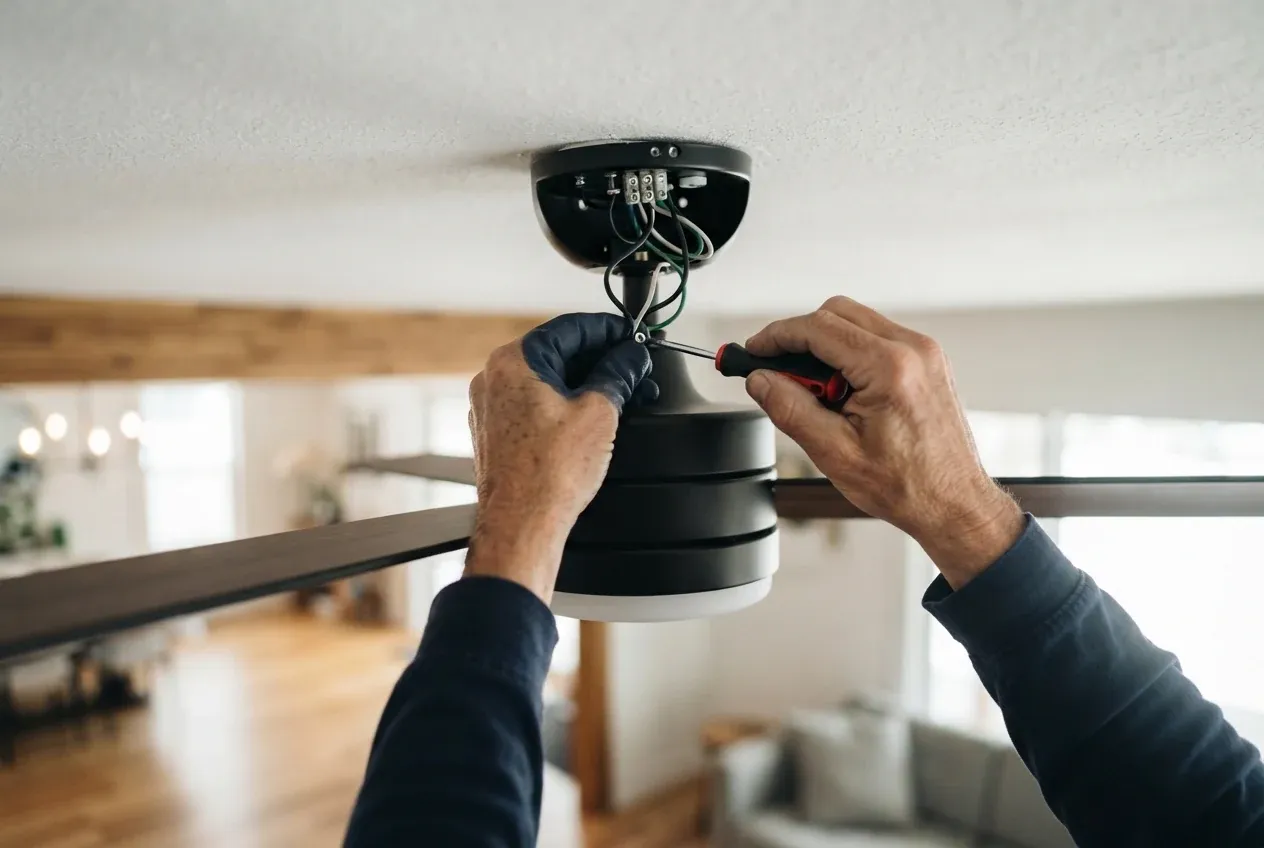
Yes, two ways. An extra wire run from the switch to the fan lets you put the fan and the light on their own wall switches, which may mean pulling new cable. A remote or smart control splits them electronically with no new wire. Decide before the install, so the work only gets done once. Switch and dimmer installation covers the wall-control side, including which dimmers can’t run a fan motor.
If the fan is part of a bigger lighting change in the room, lighting installation covers planning the rest of the fixtures around it.
Signs it's time to call
- A fan that wobbles, rattles or has gotten noisy
- Wanting a fan where only a light fixture hangs now
- A fan hung from a standard light box instead of a fan-rated one
- Fan controls that don't work reliably anymore
- Rooms the AC alone can't keep comfortable
- An outdoor fan that isn't rated for damp or wet spots
Common problems
What goes wrong with ceiling fans?
Hung on a box that isn't fan-rated
The most common fault and the most serious. A standard light box holds a still weight. A fan pushes and pulls on it every second it runs. Fan-rated boxes are braced to the framing, and fans hung on standard boxes do come down.
Wobble
Usually blades out of balance, a bent blade iron or loose mounting hardware. Wobble that won't go away wears out the mount and the box faster.
Fan and light on one switch
One switch feeding a fan with a light kit means both run together, unless a remote or an extra wire to the switch is added.
Wrong fan for the spot
Porch and patio fans need damp or wet ratings. An indoor fan outside rusts and fails quickly.
Low ceilings
Blades need clearance from the floor, and low ceilings call for a flush-mount fan instead of one on a downrod.
How the work usually goes
- Step 01
Check the box
Your electrician confirms whether the existing box is fan-rated and solidly fastened. If it isn't, it gets replaced.
- Step 02
Settle the controls
Deciding whether you want the fan and light switched separately, and what wires are there to do it.
- Step 03
Fit a rated support
Where needed, a fan-rated box or brace goes in, fixed to the joists.
- Step 04
Assemble and hang
The fan is assembled and hung on the right downrod length for the ceiling height.
- Step 05
Wire and balance
Connections are made, then the fan runs through every speed to check for wobble and get it balanced.
Read this first
What keeps a ceiling fan safely up?
A fan has to hang from a fan-rated box fastened to the framing. That's the most important part of the whole install.
Blades need clearance from the floor and the walls.
Outdoor and covered spots need fans rated for damp or wet locations.
A wobbling fan keeps loosening its own mount a little more each day.
What affects the cost
What changes the price of a fan install?
Every job is priced on what the electrician finds on site, and you only pay for work you agreed to.
- Whether a fan-rated box has to go in where there isn't one
- Ceiling height, since tall ceilings need more equipment and time
- Whether a new circuit or an extra switch wire is needed
- A replacement, or a new spot with no wiring yet
- Fan weight and how involved the fan is to assemble
- Sloped or vaulted ceilings, which need specific mounting hardware
Straight answers
Ceiling Fan Installation questions
Can a ceiling fan go where a light fixture is now?
Yes, but the box almost always has to be swapped for a fan-rated one. A light box is made for a still load, not the constant shaking a fan puts on it. That box swap is the part of the job that takes the time, especially when there's no attic above and the ceiling has to be opened.
Why does my ceiling fan wobble?
Most often the blades are out of balance, from slightly different blade weights or a bent blade iron. A balancing kit fixes most cases. If it doesn't, the mounting hardware or the box is loose, and that kind of wobble gets worse, so call.
Do ceiling fans lower cooling bills?
They can. A fan cools people, not the room, and the U.S. Department of Energy says it lets you raise the thermostat about 4°F with no loss of comfort. Running a fan in an empty room saves nothing, so switch it off when you leave.
What size ceiling fan does my room need?
Match the blade span to the room: smaller spans for bedrooms and offices, bigger ones for open living areas. Ceiling height matters too, since blades need floor clearance. Very large or long rooms often do better with two fans than one oversized one.
Before you dial
Got a fan to hang?
Your ZIP code, what the power is doing, and whether anything smells hot, sparks or buzzes.
We'll get a licensed electrician out to you, and you only pay for work you agreed to.