Service
Light Switch and Dimmer Installation and Repair
Tell us what the switch controls and what bulbs you run. A licensed electrician checks what's in the box first, so the dimmer or smart switch works with them.
Start with a call
Tell us what's going on and where the job is. We'll get a licensed electrician out, and you'll know the price before the job begins.
Why isn’t swapping a switch always simple?
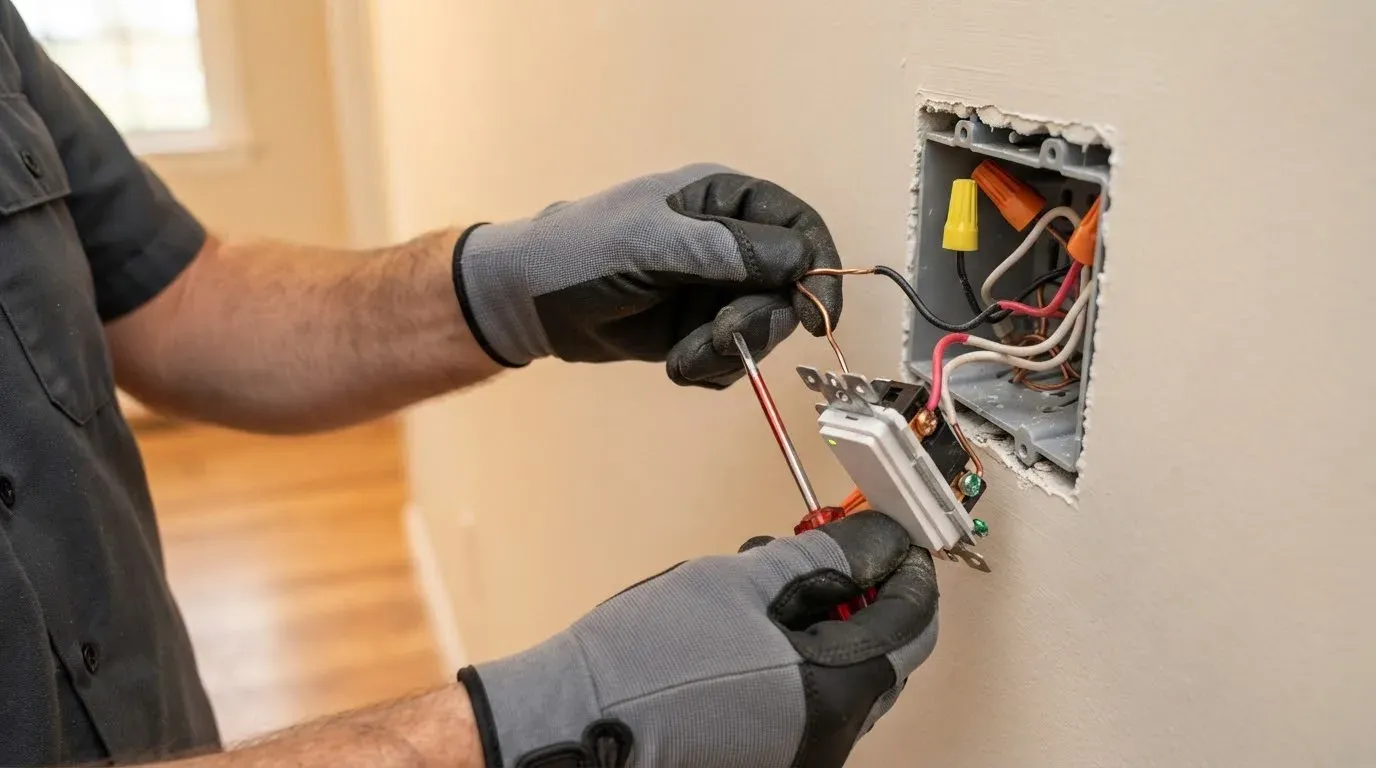
The switch on the wall is simple; the box behind it varies. A switch box can hold a basic switch loop with two wires, a full circuit passing through, travelers for switching from more than one spot, or several circuits sharing one box. When you call Hire Local Electrician about light switch or dimmer installation, tell us what the switch runs and what bulbs are in it, and the licensed electrician on your job checks the box before picking the device.
That’s why one switch swap takes ten minutes and the next one means pulling a new wire. Smart switches are the usual example: they need a neutral, and older switch loops often don’t have one.
Which switch do you need?
The right switch depends on how many spots control the light and what you want it to do.
| Switch | What it does | Worth knowing |
|---|---|---|
| Single-pole | One light from one spot | The basic swap |
| Three-way | One light from two spots | Needs travelers between the two switches |
| Four-way | Adds a third spot or more | Sits between two three-way switches |
| Dimmer | Sets brightness | Must be rated for LED if you run LED bulbs |
| Smart switch | App, voice or schedule control | Most need a neutral wire in the box |
| Timer or occupancy sensor | Turns lights on and off by itself | Some need a neutral; check the box depth |
The naming trips people up: a three-way switch has three terminals, which is where the name comes from, not the number of spots.

How do you get LED dimming right?
Three things have to agree: the bulbs must be dimmable, the dimmer must be built for that bulb type, and the total load must sit inside the dimmer’s rating, allowing for the drop when dimmers share a box. Most unhappy dimmer jobs trace back to one of those.
Tell us the bulbs you have, or plan to buy, before the dimmer gets picked. Buying the dimmer first and finding out it doesn’t suit the bulbs is the usual order of events. If you’re replacing the fixtures as well, lighting installation covers matching new fixtures to the switch, and a ceiling fan installation brings its own question about separate fan and light control.
A switch that’s warm, crackles or works only some of the time is a wiring problem, not a style upgrade; that’s electrical repair.
Signs it's time to call
- A switch that buzzes, feels warm or has turned unreliable
- Lights that flicker or hum when dimmed
- Wanting to control one light from two or more spots
- A smart switch that won't work in the existing box
- Dimmers that only work over part of their range
- Switches that no longer click firmly
Common problems
Why do switches and dimmers act up?
Dimmer and bulb mismatch
The most common complaint after a dimmer goes in. Plenty of LED bulbs aren't dimmable, and the ones that are need a dimmer rated for LED. The signs are flicker, buzz, a short dimming range or bulbs that drop out at the low end.
No neutral in the switch box
Most smart switches need a neutral wire to power their electronics. Older switch loops often carry only the hot. That's the usual reason a smart switch can't just be swapped in.
Three-way switches wired wrong
Running one light from two spots uses travelers between the switches. Get them mixed up and the light only works when the other switch is in one position.
Worn switch mechanisms
Switches are good for a limited number of flips. One that buzzes or feels mushy inside is wearing out, and one making heat is a fault worth fixing now.
Overloaded dimmers
Dimmers have a wattage rating, and it drops when several are ganged in one box. Go over it and the dimmer overheats.
How the work usually goes
- Step 01
See what's in the box
Your electrician checks which wires are there, especially whether there's a neutral, before recommending a device.
- Step 02
Match the device to the load
For dimmers, matching the dimmer type to the bulbs already installed.
- Step 03
Kill and verify
Confirming the circuit is dead, which matters most in switch loops where looks can fool you.
- Step 04
Install and connect
The device goes in with proper connections and a box that isn't overstuffed.
- Step 05
Test the full range
Dimmers get tested from top to bottom, not just on and off, because that's where mismatches show up.
Read this first
Is a switch box safe with the switch off?
A switch box can hold live wires even with the switch off. Never trust the switch position to make a box safe.
Dimmers must be rated for the bulbs. A standard dimmer on LED bulbs is a common cause of flicker and early failure.
A switch plate that's warm with a plain on-off switch behind it means heat from a loose connection. Leave the light off until it's checked.
What affects the cost
What moves the price of a switch job?
Every job is priced on what the electrician finds on site, and you only pay for work you agreed to.
- Device type, since smart switches and good dimmers cost more than standard switches
- Whether a neutral has to be run to the switch box
- Whether new travelers are needed for switching from more than one spot
- Box size, since older boxes sometimes can't fit a smart switch
- How many switches get done in one visit
Straight answers
Switch Installation questions
Why do my LED lights flicker on a dimmer?
Almost always a mismatch. Either the bulbs aren't dimmable, or the dimmer was built for old incandescent loads. LEDs draw so little current that many older dimmers can't run them smoothly. The fix is a dimmer rated for LED and matched to the bulbs you have.
Can I put a smart switch anywhere?
Not always. Most need a neutral wire, and many older switch boxes only have the switched hot. Some models work without a neutral, with limits. Box depth matters too, since smart switches are bulkier and old shallow boxes sometimes can't fit one safely.
Why is my light switch buzzing or hot?
A dimmer can run a little warm and hum faintly with some bulbs. A plain switch that buzzes or feels warm, or a dimmer that's hot, usually means a loose connection, an overloaded dimmer or a worn mechanism. Turn it off, leave it off, and call.
Why does my three-way switch only work when the other one is flipped?
That's the classic sign of travelers landed on the wrong terminals, often after one of the switches was replaced. Nothing is broken; it's wired wrong. Moving the wires to the right terminals fixes it, which takes testing to find which wire is which.
Can a second switch be added without opening walls?
Often, yes. Wireless and smart switch kits can add a second control spot without pulling travelers through finished walls. The devices cost more, but skipping the wall work can make the job cheaper overall.
Before you dial
Dimmer flickering or switch warm?
Your ZIP code, what the power is doing, and whether anything smells hot, sparks or buzzes.
We'll get a licensed electrician out to you, and you only pay for work you agreed to.