Service
Whole-Home Surge Protection Installed at Your Panel
Tell us your panel make and what you want protected. A licensed electrician checks the grounding first, then mounts a surge protector at the panel.
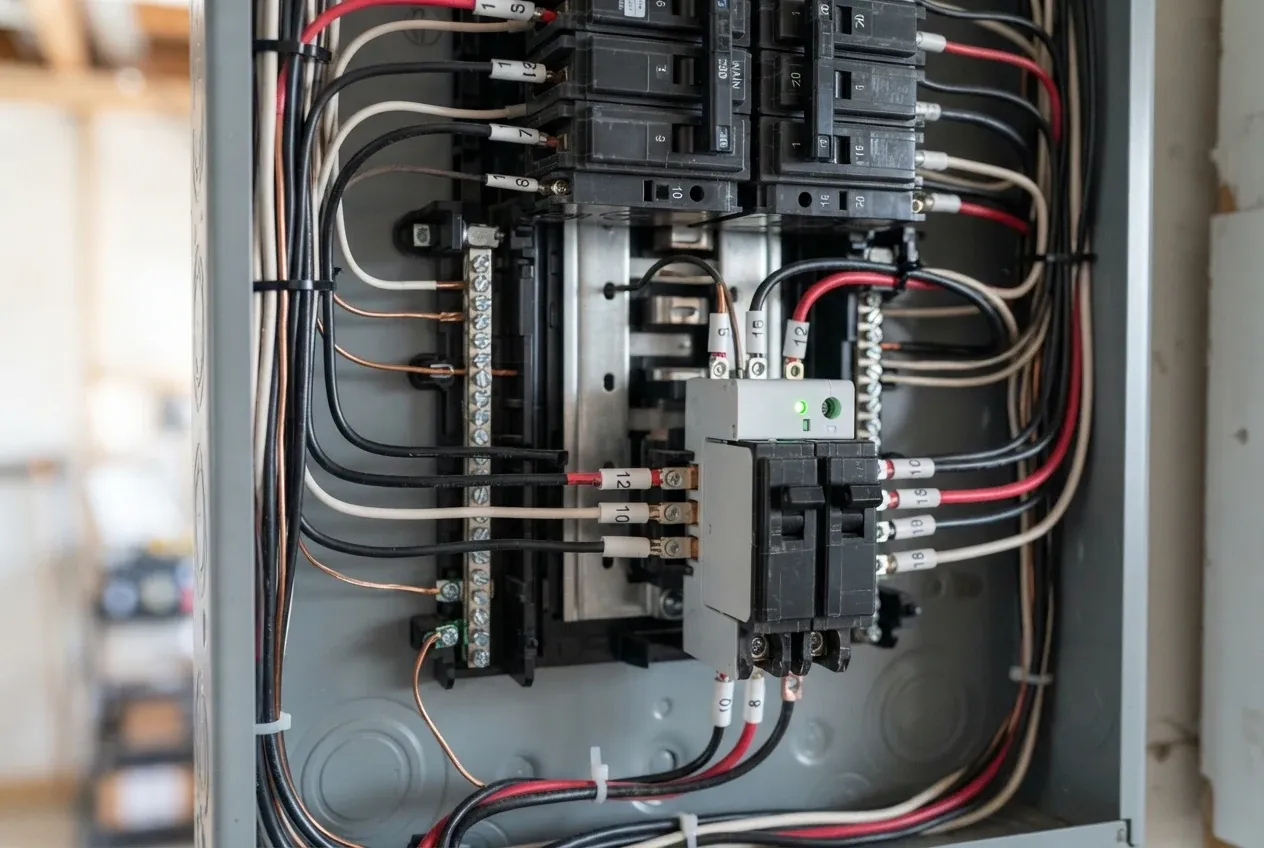
Start with a call
Tell us what's going on and where the job is. We'll get a licensed electrician out, and you'll know the price before the job begins.
Where do most power surges come from?
Most surges come from inside your own house. Every time the AC, fridge or washer motor cycles, it puts a small voltage spike on your wiring, and grid switching outside adds more. Lightning is the rare, dramatic case. Call Hire Local Electrician about whole-home surge protection, tell us your panel make, and a licensed electrician checks the grounding before fitting a device at the panel.
A surge lasts microseconds to milliseconds, and modern electronics handle them badly. The damage usually adds up: a board rarely dies from one spike, it dies after enough of them, and by then the cause is invisible and it gets blamed on bad luck.
Type 1, Type 2 or Type 3: which surge protector goes where?
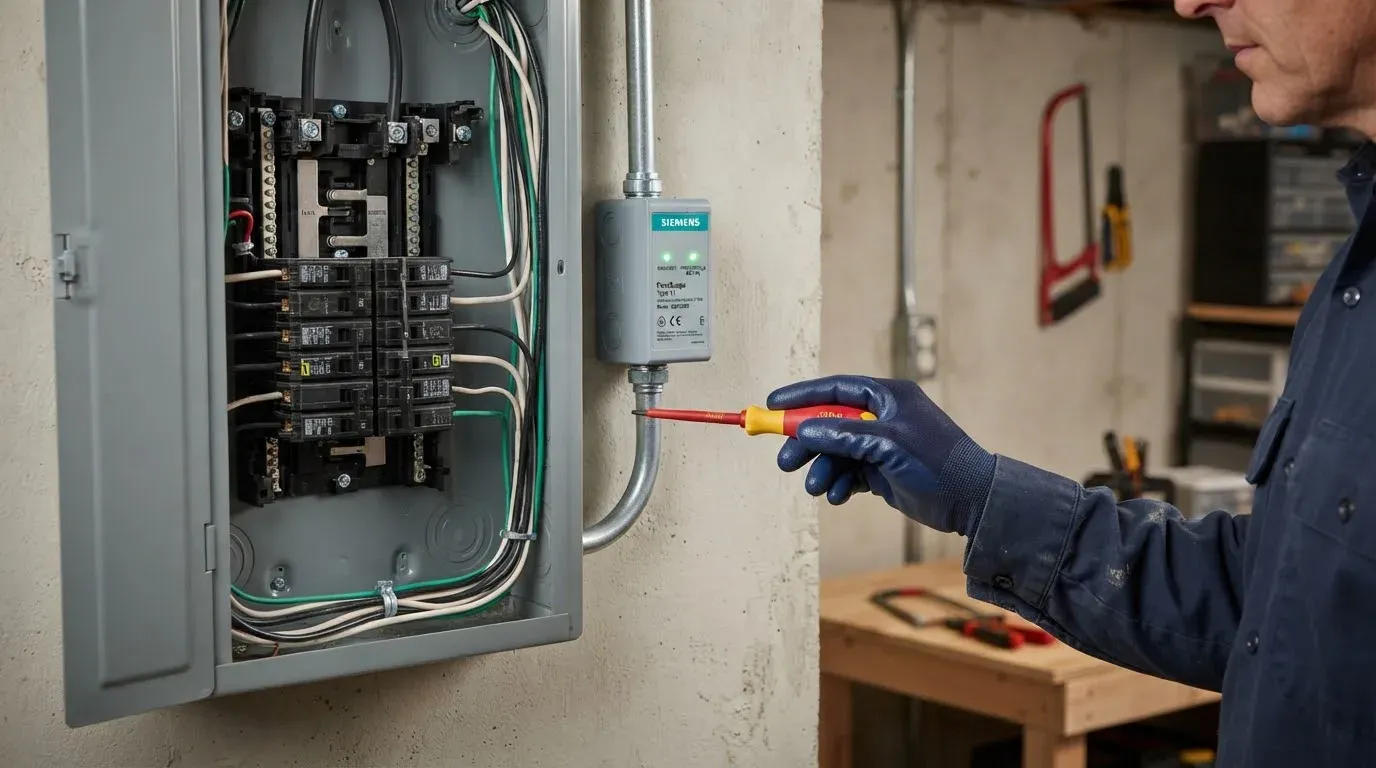
Surge protective devices come in types, under the UL 1449 standard, that describe where they’re installed. A sound setup usually has two layers: one at the panel and one at the electronics you care most about.
| Type | Where it goes | What it covers |
|---|---|---|
| Type 1 | At the service, ahead of or at the main disconnect | Surges coming in from the utility side, including nearby lightning |
| Type 2 | In or beside the main panel, on a breaker | Everything the panel feeds, hardwired appliances included |
| Type 3 | At the outlet: surge strips and surge-rated outlets | Whatever is plugged into it |
Neither layer alone covers everything. A panel device won’t stop the spike your own AC puts on a shared circuit, and a surge strip does nothing for the furnace. Newer editions of the electrical code also call for a surge protector when a home’s service is replaced, so if an electrical panel upgrade is coming, it’s often handled at the same time.
Why does grounding come first?
A surge protector works by dumping excess voltage to ground, so with a weak ground it has nowhere to send it. If the grounding electrode system is poor or the circuits have no ground at all, that gets fixed before the device goes in. Otherwise the device can’t do its job.
In older homes, that often means checking the ground rod and the water-pipe bond, and sometimes running grounds to key outlets; outlet installation covers replacing two-prong outlets properly. Not sure what shape your grounding is in? It’s one of the main things an electrical inspection looks at.
Signs it's time to call
- Electronics and appliance boards failing more often than they should
- Lights that dip or flicker when big appliances start
- A house full of electronics, smart devices and appliances with circuit boards
- Frequent storms, grid switching or overhead lines in your area
- No surge protector at the panel
- Circuits with no ground, which stop surge protection from working at all
Common problems
Where do damaging surges come from?
Surges made inside the house
Most surges start indoors: motors in the AC, the fridge and the washer kick out voltage spikes every time they cycle. Each one is small, and they add up.
Utility switching
Routine grid switching, capacitor banks and lines resetting after a fault all send spikes down the incoming supply.
Lightning
The dramatic case and the least common. A direct hit overwhelms almost any protection, but nearby strikes induce surges a properly installed device can handle.
Power strips alone
A surge strip protects what's plugged into it. It does nothing for hardwired equipment: the furnace and AC, the oven, the dishwasher, the garage door opener, or the circuit boards inside modern appliances.
Missing or poor grounding
A surge protector works by sending excess voltage to ground. Without a good ground path it has nowhere to send it, which is why an ungrounded house needs the grounding fixed first.
How the work usually goes
- Step 01
Check grounding and bonding
Your electrician confirms the grounding electrode system and bonding are sound, since surge protection depends on them.
- Step 02
Look at the panel
Confirming there's room and a suitable connection point for a surge protective device.
- Step 03
Install at the panel
The device goes in with the shortest practical wire leads, since lead length affects how well it works.
- Step 04
Add point-of-use protection
A second layer at sensitive equipment, since a panel device cuts surges down but doesn't stop all of them.
- Step 05
Show you the status light
Surge protectors have an indicator that shows whether they're still working. You'll know where it is and what it should show.
Read this first
Why do surge protectors stop working?
Surge protection needs a proper ground. On a poorly grounded system, a surge protector does very little.
Surge protectors wear out. They soak up energy over their life and eventually stop protecting, usually with no sign except the status light.
A device installed with long leads works noticeably worse. Short leads are part of a good install.
What affects the cost
What affects the cost of surge protection?
Every job is priced on what the electrician finds on site, and you only pay for work you agreed to.
- The device's rating and build quality
- Whether the panel has room and a suitable connection point
- Whether grounding or bonding needs fixing first, common in older homes
- How many point-of-use devices get added
- Whether the panel takes a breaker-style device or needs one mounted beside it
Straight answers
Surge Protection questions
Is a whole-home surge protector worth it?
For most homes, yes. Most surges start inside the house and wear down circuit boards a little at a time. A panel device covers hardwired equipment a power strip can't reach, like the furnace, AC, range and dishwasher, whose control boards are expensive to replace.
How long does a surge protector at the panel last?
There's no fixed lifespan. The device absorbs energy over time, so a house that sees frequent spikes wears one out faster. Check the status light every so often, and after any big storm or outage, because a worn-out device gives no other sign.
Do I need surge protection if lightning is rare where I live?
Yes. Lightning is the least common source. The motors in your own appliances make spikes every time they cycle, and utility switching adds more. Those are what wear electronics down over the years, and they happen everywhere.
Can a surge protector be added to any panel?
Most modern panels take a breaker-style device, or one mounted beside the panel on a two-pole breaker. The limits are space and panel type; some old panels have no compatible option, which is one more reason they tend to get replaced. Grounding gets checked first either way.

Before you dial
Electronics failing too often?
Your ZIP code, what the power is doing, and whether anything smells hot, sparks or buzzes.
We'll get a licensed electrician out to you, and you only pay for work you agreed to.