Service
Lighting Installation for Recessed, Fixture and Outdoor Lights
Tell us the room and what's wrong with the light now. A licensed electrician plans the layout, checks the ceiling and switching, and gets the room lit properly.

Start with a call
Tell us what's going on and where the job is. We'll get a licensed electrician out, and you'll know the price before the job begins.
What makes a room feel poorly lit?
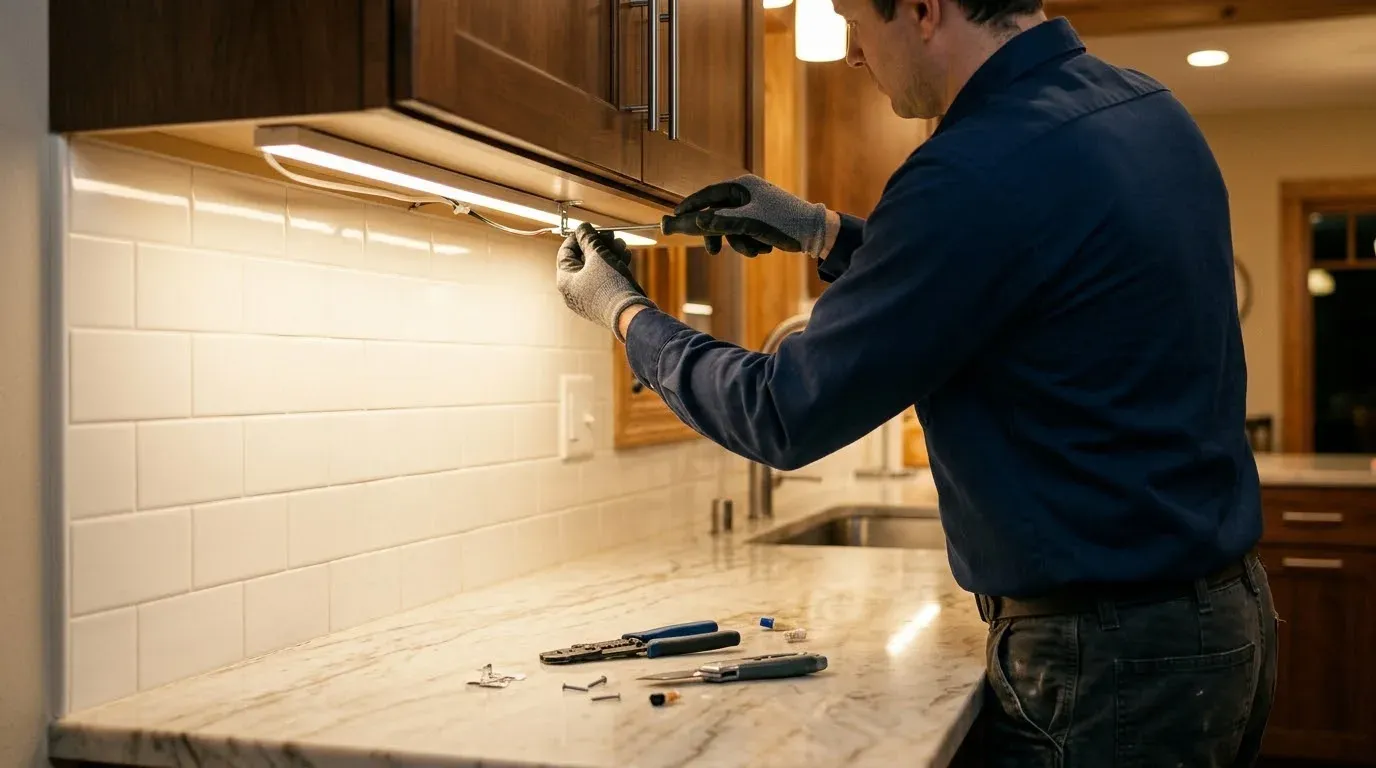
A room usually feels dim because it’s missing a layer of light, not because the bulb is too weak. Lighting works in three layers: ambient light fills the room, task light hits the surfaces where you work, and accent light picks out a wall, a shelf or a piece of art. Call Hire Local Electrician with the room and what bugs you about the light, and we’ll get a licensed electrician out to plan the lighting installation around those layers.
A room lit only by one ceiling fixture feels flat, and one lit only by task lights feels patchy. Putting a brighter bulb in a single center fixture rarely fixes either.
Which fixture rating does each spot need?
Every fixture is rated for where it can go, and the rating is printed on the box or the label. Here’s how the ratings usually line up with rooms; local code may differ.
| Rating | Where it goes | Examples |
|---|---|---|
| Dry location | Indoor rooms that stay dry | Bedrooms, living rooms, hallways |
| Damp location | Covered spots with humidity or condensation | Bathrooms outside the shower spray, covered porches, basements |
| Wet location | Anywhere water hits the fixture directly | Inside a shower where spray reaches, open patios, exposed walls |
| IC-rated recessed | Can sit in direct contact with insulation | Any insulated ceiling under an attic |
| Non-IC recessed | Needs clearance from insulation | Ceilings with no insulation around the fixture |
Fixture swap or new layout?
A swap where a fixture already hangs is a contained job. Adding lights where there are none means pulling cable, cutting openings and often adding or moving switches, which is a much bigger scope. If new switching or dimmers are part of it, switch and dimmer installation covers matching the dimmer to the bulbs.
In an older house, the existing connection is often where tired wiring shows up. Fixture connections run warm for decades, and the insulation at that spot gets brittle, so a simple swap can turn up a connection that needs remaking. If the fixture you’re replacing is going to be a fan, see ceiling fan installation, since a fan needs a fan-rated box.

What does outdoor lighting need?
Outdoor lighting needs wet-rated fixtures, weather-resistant GFCI outlets with in-use covers, and buried cable run the way code requires for its depth and type. Low-voltage landscape lighting runs off a transformer, which loosens some rules on the light side, but the transformer still plugs into or wires to a proper outdoor circuit. Tell us where the lights go and how far they are from the house when you call.
Signs it's time to call
- Rooms that are dim or lean on lamps for everyday light
- Fixtures that are dated, damaged or failing
- A kitchen with no light over the counters
- A yard, driveway or steps with no light at night
- Fixtures that flicker or have turned unreliable
- Wanting to move off incandescent or halogen to LED
Common problems
Why does a room light badly?
One fixture trying to light a whole room
Plenty of rooms were built with a single center fixture, which leaves corners dark and throws shadows. The fix is usually several fixtures in a layout, not a brighter bulb in one.
No light where the work happens
Counters, workbenches and desks need light aimed at the surface. A ceiling fixture behind you just puts your own shadow on the work.
Fixtures that don't suit the spot
Bathrooms, showers and outdoor spots need fixtures rated for damp or wet locations. Indoor fixtures in those places corrode and turn into a hazard.
Recessed lights buried in insulation
Recessed fixtures that aren't IC-rated have to be kept clear of insulation. That gets ignored in a lot of retrofits, and it's a real fire risk in an insulated ceiling.
Heavy fixtures on light-duty boxes
Chandeliers and large fixtures need a box rated for their weight or separate support. Standard boxes aren't built for it, and fixtures do come down.
How the work usually goes
- Step 01
Plan the layout
For anything past a straight swap, deciding placement, spacing and how the lights will be switched.
- Step 02
Check circuits and switching
Seeing whether the existing circuits and switch spots suit the plan, and what has to be added.
- Step 03
Cut and run
Openings get cut and cable pulled, working around joists, insulation and any fire-rated ceiling.
- Step 04
Mount and connect
Fixtures go up on the right boxes and supports, properly connected.
- Step 05
Test and aim
Running the lights through the full dimming range and aiming any adjustable fixtures.
Read this first
Which fixtures are safe where?
Recessed lights in an insulated ceiling must be IC-rated or kept the required distance from insulation. Covering a non-IC fixture is a fire risk.
Bathrooms and outdoor spots need fixtures rated for damp or wet locations.
Old fixtures can hide brittle wiring at the connection, which is common in older homes. Expect it to be checked when the fixture comes down.
What affects the cost
What sets the cost of new lighting?
Every job is priced on what the electrician finds on site, and you only pay for work you agreed to.
- Number of fixtures and how involved the layout is
- Ceiling access, since an open attic above is much easier than a finished ceiling under another floor
- Whether new circuits or switch spots are needed
- The fixtures themselves, which vary enormously in price and are usually bought separately from the labor
- Whether dimming is included, and what kind
- Ceiling patching and painting afterwards
Straight answers
Lighting Installation questions
How many recessed lights does a room need?
It depends on ceiling height, room size, the fixtures' beam angle, wall color and what the room is for. A common starting point spaces fixtures about half the ceiling height apart, then adjusts. A kitchen needs more light than a living room, and over-lighting a living room is a common mistake.
Can recessed lighting go in any ceiling?
Most, but the details matter. Joists limit where the cans can go. Insulated ceilings need IC-rated fixtures. Fire-rated ceilings, often between floors in condos and townhomes, need fixtures that keep the rating. Concrete ceilings are a different job entirely. The ceiling gets checked before the layout is final.
Should I switch everything to LED?
Generally, yes, for both power use and bulb life. Two catches. The dimmer has to suit the bulbs, and mixing brands or batches in one room gives visibly different whites. If you're changing bulbs over time, note the brand and color temperature you bought.
Do I need a permit for lighting work?
A straight fixture swap on an existing circuit usually doesn't need one. New circuits, new fixture locations or changes to the wiring usually do, though it varies by city and county. Your electrician knows the local rule and pulls the permit when it's needed.
Can a chandelier hang from any ceiling box?
Not a heavy one. Code requires a ceiling box to hold at least 50 pounds; a fixture heavier than that needs support independent of the box, or a box listed for the weight. Tell us the fixture's weight when you call so the right support goes in.

Before you dial
Room too dark or too flat?
Your ZIP code, what the power is doing, and whether anything smells hot, sparks or buzzes.
We'll get a licensed electrician out to you, and you only pay for work you agreed to.