Service
Electrical Troubleshooting for Faults You Can't Pin Down
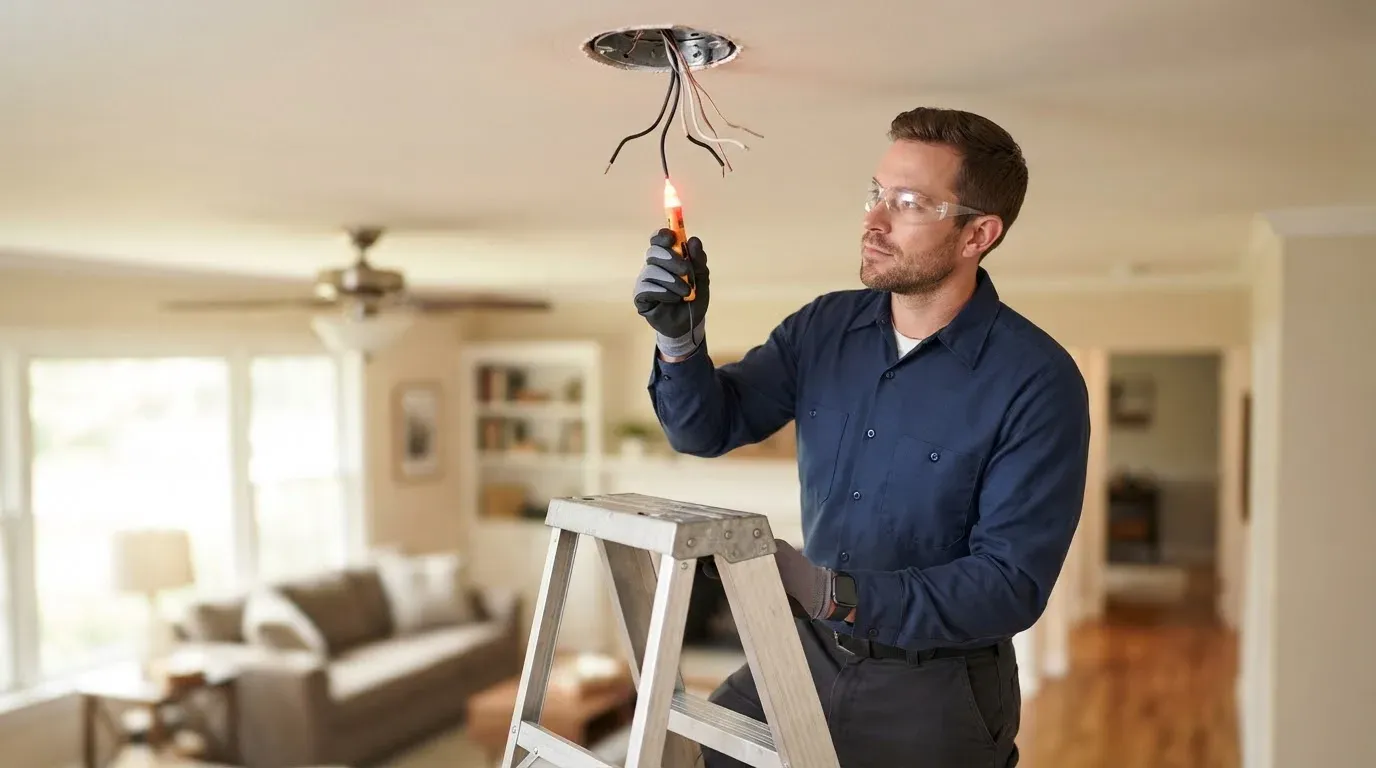
Tell us when it happens and what else is running. A licensed electrician tests the circuit under those same conditions and tracks the fault to its source.
Start with a call
Tell us what's going on and where the job is. We'll get a licensed electrician out, and you'll know the price before the job begins.
Why are some electrical faults so hard to find?
Electrical faults hide. You can’t see current, and most of the wiring is behind drywall, so a fault has to be found from the symptoms at outlets, switches and the panel. Electrical troubleshooting is that detective work, and when you call Hire Local Electrician with a fault nobody can pin down, the licensed electrician we get out to you tests it methodically instead of swapping parts until something works.
Faults that come and go make it harder. A loosened connection can hold fine when it’s cold and open up when it warms. The lights flicker every evening once the heat runs, then behave perfectly when someone arrives at 10 a.m. If the dimming lines up with the air conditioner starting, our guide to lights that dim when the AC kicks on explains which cases are normal and which aren’t.
What is the symptom telling you?
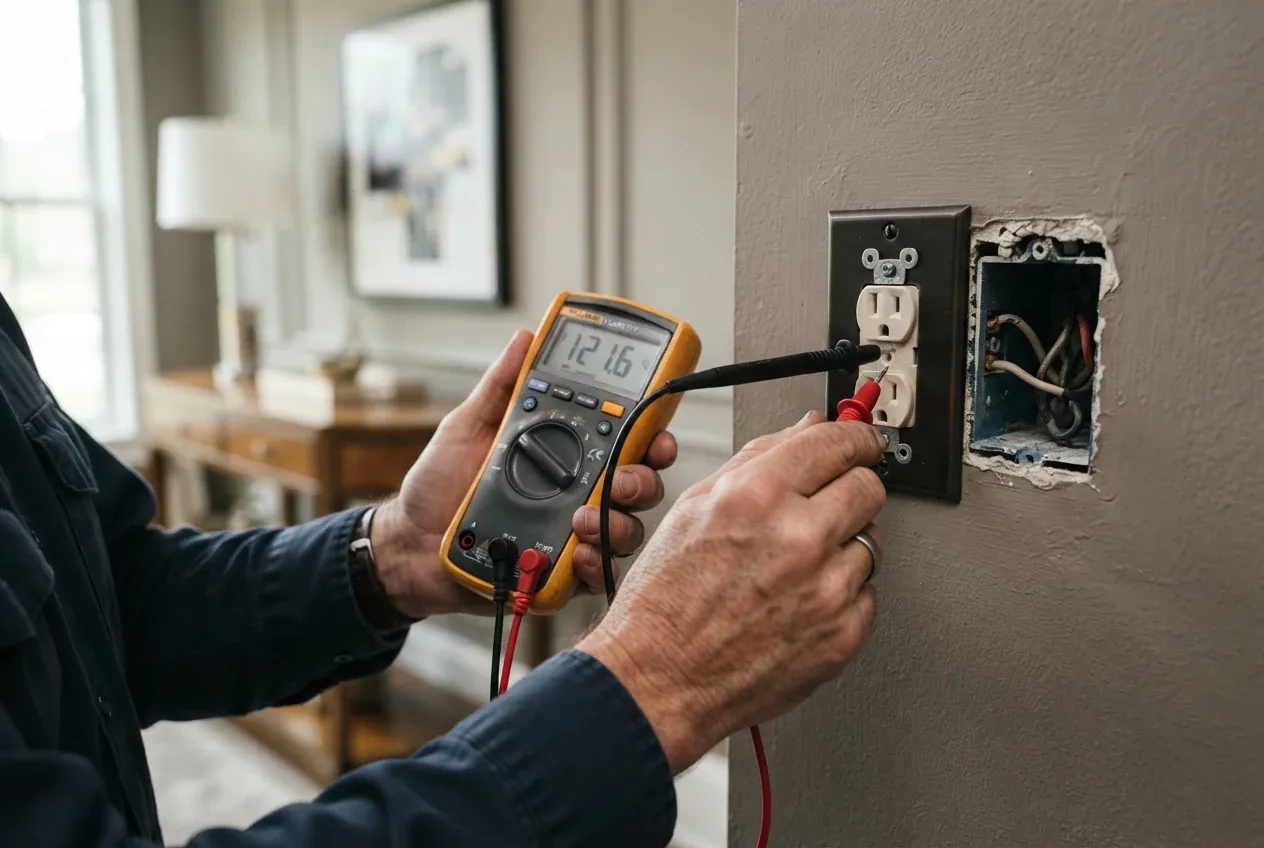
The symptom narrows the cause and tells you how fast to act. Use this as a starting point, not a diagnosis.
| What you’re seeing | What usually causes it | How soon to call |
|---|---|---|
| One light flickers | Loose bulb, bad fixture connection, dimmer that doesn’t suit the bulb | Book a visit |
| Lights across the house brighten and dim | Loose neutral at the panel or service | Today, and unplug electronics |
| Half the house is dead | A lost service leg, failed main breaker or the utility side | Now, if neighbors have power |
| A row of outlets is dead | A tripped GFCI elsewhere or a failed connection at the last working outlet | Book a visit |
| Breaker trips at random | Loose connection, arcing or a worn breaker | Soon, or now if there’s heat or a smell |
| Burning smell you can’t find | Overheating insulation or a connection cooking inside a box | Now: switch the circuit off and call |
Some of those rows are emergencies and some can wait for a booked visit. Is it an emergency, or can it wait? walks through the gray areas, and anything with heat or smell goes straight to an emergency electrician. If the trouble is one breaker that won’t stay on, circuit breaker repair is the closer fit.
What details help find the fault faster?
The pattern is the most useful thing you can give us. When does it happen? What else is running? Did anything change: a new appliance, recent work, a storm, a leak? People often apologize for not knowing what’s wrong, but those observations are exactly what narrows the search.
Jot down the time and what was running the next time it happens. Two or three of those notes can save an hour of testing.
Why do panel labels matter so much?
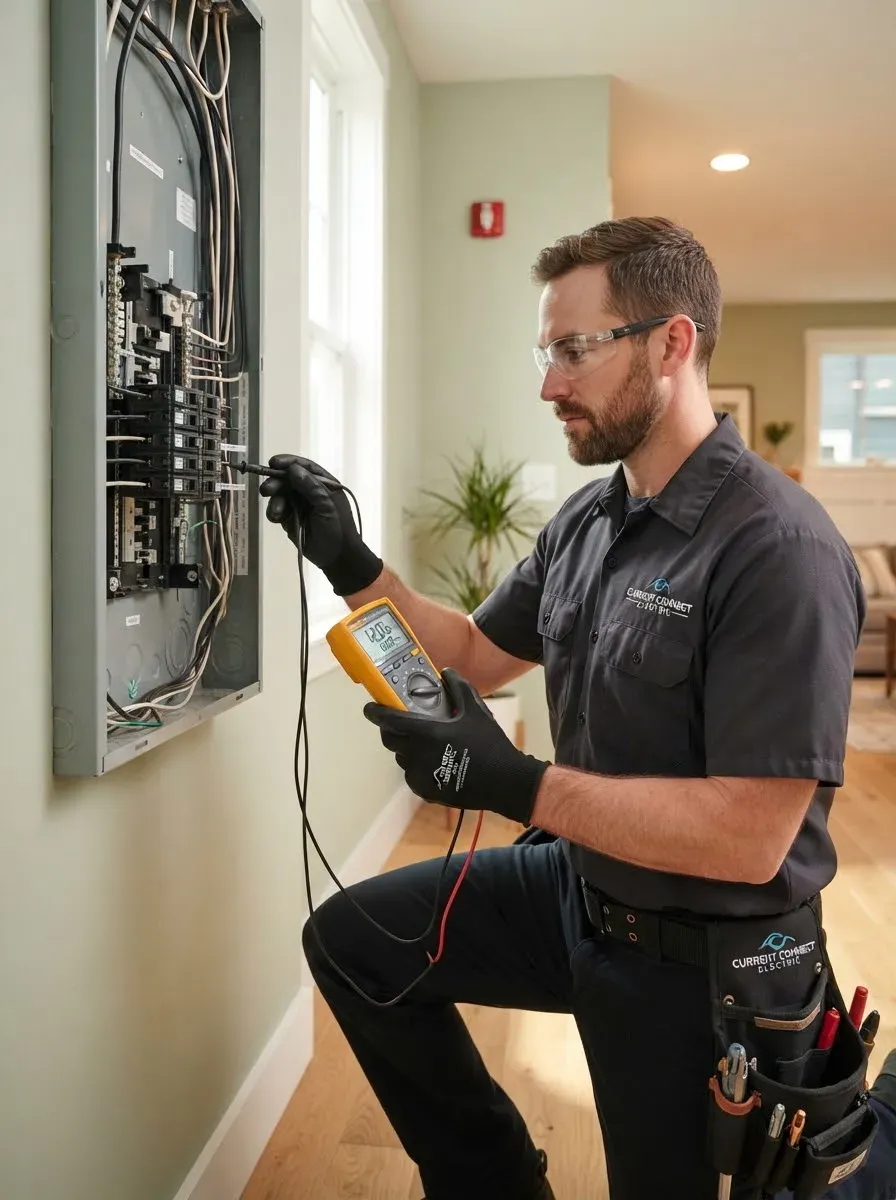
A good share of troubleshooting time in older homes goes into working out what’s really on each circuit, because panel labels are often inherited, half-filled or plain wrong. If yours are accurate, the job goes faster. If they’re not, ask for the panel to be labeled properly while the electrician is there. Once the fault is found, the fix itself is ordinary electrical repair.
Signs it's time to call
- Lights that flicker or dim with no obvious trigger
- Outlets that work sometimes and not others
- A circuit that trips now and then, at no predictable time
- A burning smell you can't trace
- Several unrelated symptoms showing up around the same time
- Buzzing that moves around or changes with load
Common problems
What causes faults that come and go?
Loose but touching connections
A connection that's loose but still touching works until heat, vibration or load breaks contact. These are the hardest faults to find, because everything tests fine while the electrician is standing there.
Shared or crossed neutrals
Circuits changed over the years sometimes share neutrals in ways that cause strange behavior on several circuits at once. The symptoms often look unrelated.
A failing device upstream
One worn outlet or switch can cause trouble on everything after it, so the symptom shows up a room or two away from the cause.
A loose neutral at the service
Lights getting brighter in one part of the house while they dim in another is the classic sign. It can damage electronics and needs attention fast.
Faults that only show under load
Some faults only appear when the dryer runs or the heat kicks on. Finding them means testing under the conditions that cause them.
How the work usually goes
- Step 01
Get the pattern
When it happens, what else is running, and whether anything changed lately. That narrows the search before a meter comes out.
- Step 02
Map the circuit
Working out what's really on each circuit, which often isn't what the panel labels say.
- Step 03
Test point by point
Voltage, continuity and load tests at points along the circuit isolate the fault to one section.
- Step 04
Recreate the conditions
For faults that come and go, your electrician recreates whatever sets them off.
- Step 05
Confirm and repair
Once the fault is found, it gets fixed and the circuit is tested again.
Read this first
When should a fault worry you?
A burning smell with no visible source is a reason to call, not to go looking. Overheating insulation inside a wall isn't something you can safely find yourself.
Lights brightening in one room while they dim in another points to a lost neutral. Unplug electronics and treat it as urgent.
Don't assume a fault is gone because the symptom stopped. Faults that come and go come back.
What affects the cost
Why is fault-finding priced on time?
Every job is priced on what the electrician finds on site, and you only pay for work you agreed to.
- How long the fault takes to find, which is often the bigger part of the job
- Faults that come and go take longer than ones that are always there
- Access to the circuit and whether a wall has to be opened
- How many circuits are involved
- Whether the panel labels are accurate, since bad labels add time
Straight answers
Electrical Troubleshooting questions
My lights flicker when the AC kicks on. Is that serious?
A short dip when a big motor starts is normal, because the compressor pulls a surge on startup. Flicker that lasts or keeps getting worse is worth checking. Lights getting brighter elsewhere at the same moment can mean a loose neutral, so call right away.
Why does half my house have no power?
Usually one of the two legs feeding your panel has dropped. That can be at the main breaker, the meter, the service connection or the utility side. Lights on one side die and 240 volt appliances like the dryer may stop. If the neighbors have full power, the problem is likely at your house. Call us.
The problem stopped on its own. Do I still need someone?
Usually yes, especially if it involved heat, a smell or a shock. Faults that come and go don't repair themselves. A connection that arcs now and then makes heat each time, and it tends to get worse.
Can a fault be found without opening walls?
Often, yes. Testing from outlets, switches, junction boxes and the panel pins most faults to one run. A wall gets opened only when the fault is confirmed inside a section nobody can reach, and by then the spot is known, not guessed.
Before you dial
Fault coming and going?
Your ZIP code, what the power is doing, and whether anything smells hot, sparks or buzzes.
We'll get a licensed electrician out to you, and you only pay for work you agreed to.