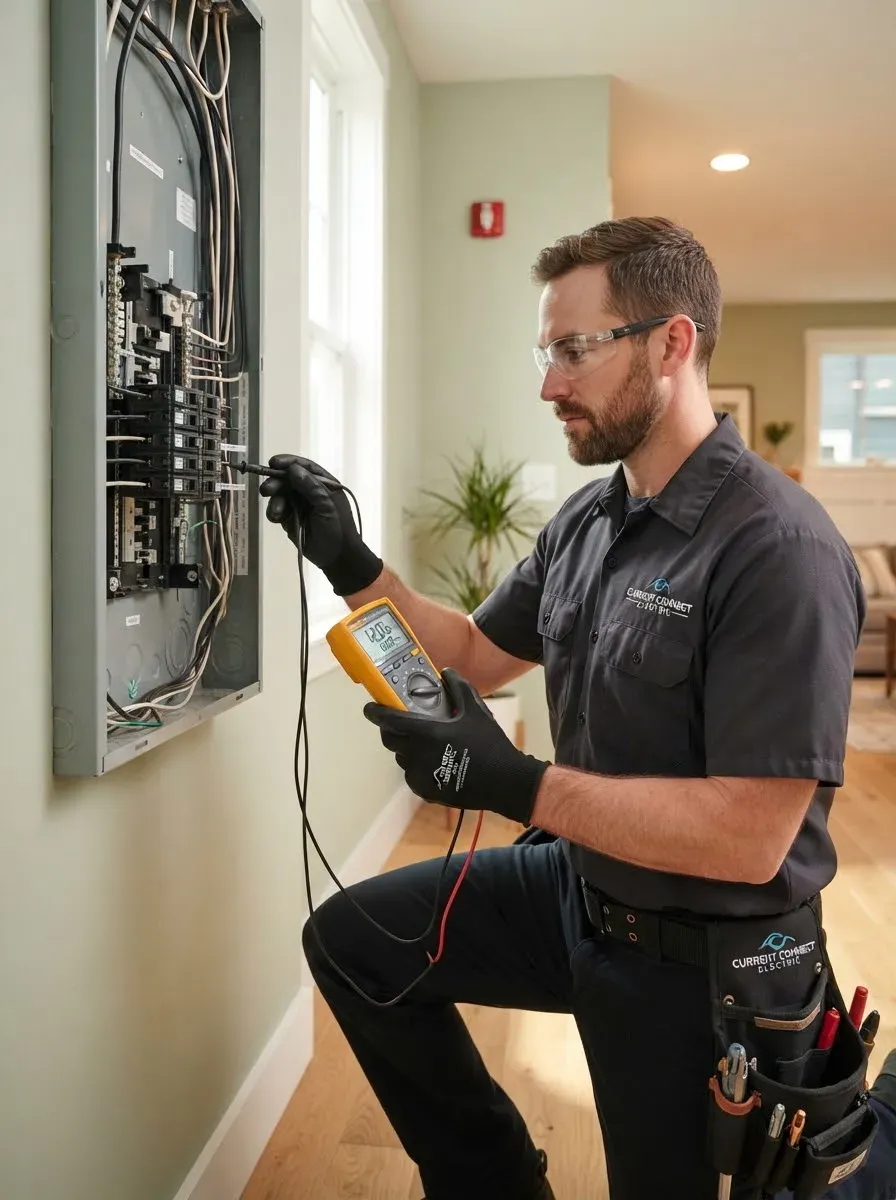
An electrical problem is an emergency when there’s heat, burning, arcing, a shock, or water reaching anything electrical. Those mean current is going somewhere it shouldn’t, and it can turn into a fire or an injury before morning. A dead outlet or a light that quit, with no heat or smell, can usually wait for a regular visit.
Call Hire Local Electrician about either kind. For the first, we treat it as an emergency and get a licensed electrician out. For the second, we’ll set a time that suits you. The cases in between are where people get stuck.
What counts as an electrical emergency?
Call right away for any of these:
- A burning smell. Hot insulation or plastic smells sharp, sometimes fishy. The source often isn’t where the smell is strongest, because it travels through wall cavities.
- Smoke, scorch marks or sparks that keep coming. One small flash when a plug goes in is normal. Repeated arcing and black marks are not.
- Any shock. Even a mild tingle from an appliance, a switch or a faucet. How hard it bit tells you little about how bad the fault is.
- Heat. An outlet, switch plate, cord or panel cover that’s warm to the touch.
- Water on or near anything electrical. A leak or flood near outlets, the panel or wiring.
- Buzzing or crackling from the panel.
- A breaker that trips again the moment you reset it. It has found a fault it won’t tolerate.
- Lights going brighter in one room while they dim in another. That points at a failing neutral, which can push damaging voltage into everything plugged in.
If you smell burning or see smoke and think there could be a fire, get everyone out and call 911 first. Electrical fires can smolder inside a wall for a long time before anything shows.
What can wait for a regular visit?
These can usually wait, as long as you shut off the circuit:
- a single dead outlet that isn’t warm and doesn’t smell
- a light fixture that stopped working
- a breaker that tripped once under an obvious heavy load and then held
- a switch that works some of the time but isn’t warm or buzzing
- flickering limited to one fixture
Switch off the breaker that feeds the problem. That one step removes the immediate risk in most of these cases. Then call us during the day and we’ll set a time for a licensed electrician to come out.
What about the cases in between?
Some problems don’t look dramatic but shouldn’t sit.
Half the house is out while the neighbors have power. Losing half the house points to the service or the panel, not a branch circuit. Our guide on why half your house lost power explains what’s going on and what to switch off.
A burning smell that came and went. It hasn’t fixed itself. Something got hot enough to smell, and whatever caused it is still there. The guide to hot, sparking or smelly outlets covers where that heat usually comes from.
An outdoor GFCI that trips every time it rains. The GFCI is doing its job and sensing real leakage. It’s rarely an emergency, but the water path needs finding rather than resetting all season. See why a GFCI won’t reset.
A breaker that trips a few times a week. Not usually urgent on day one, but it’s telling you something about the circuit. Our guide on why breakers keep tripping helps you tell an overload from a fault.

What should I do while I wait?
- Shut off the breaker for the affected circuit, if the panel is dry and you can reach it safely.
- If the panel itself is hot, buzzing or wet, stay away from it.
- Don’t keep resetting a breaker or GFCI that trips straight away.
- Unplug anything that was running when the problem started, unless the plug is hot or scorched.
- Keep kids and pets away from the outlet, fixture or panel.
What should I say when I call?
The pattern is what narrows it down. Tell us when it started, what was running at the time, and whether anything changed recently: a new appliance, recent electrical work, a storm, a leak. Say whether you’ve smelled anything or felt heat. That helps the electrician arrive with the right parts and the right plan, and it can turn a long search into a short repair.
If it’s on the emergency list, call now and we’ll get a licensed electrician out as an emergency electrician call. If it can wait, shut the circuit off and call when it suits you. You’ll know what the repair costs before it begins.