The year a house was built is one of the best clues to what’s inside its walls. Wiring methods changed in fairly clear stages, so knowing roughly when a home was wired tells you which problems to look for: knob-and-tube in the oldest houses, ungrounded outlets and small services after the war, aluminum branch circuits in a short window around 1970, and thin GFCI and AFCI protection in homes built before those rules expanded.
When you call Hire Local Electrician about an older house, tell us the year it was built and what’s bothering you, and we’ll get a licensed electrician out to see what’s actually there. Homes get rewired, added to and patched over the decades, so the year points to the right questions and the visit answers them.
Does a house built before 1950 have knob-and-tube?
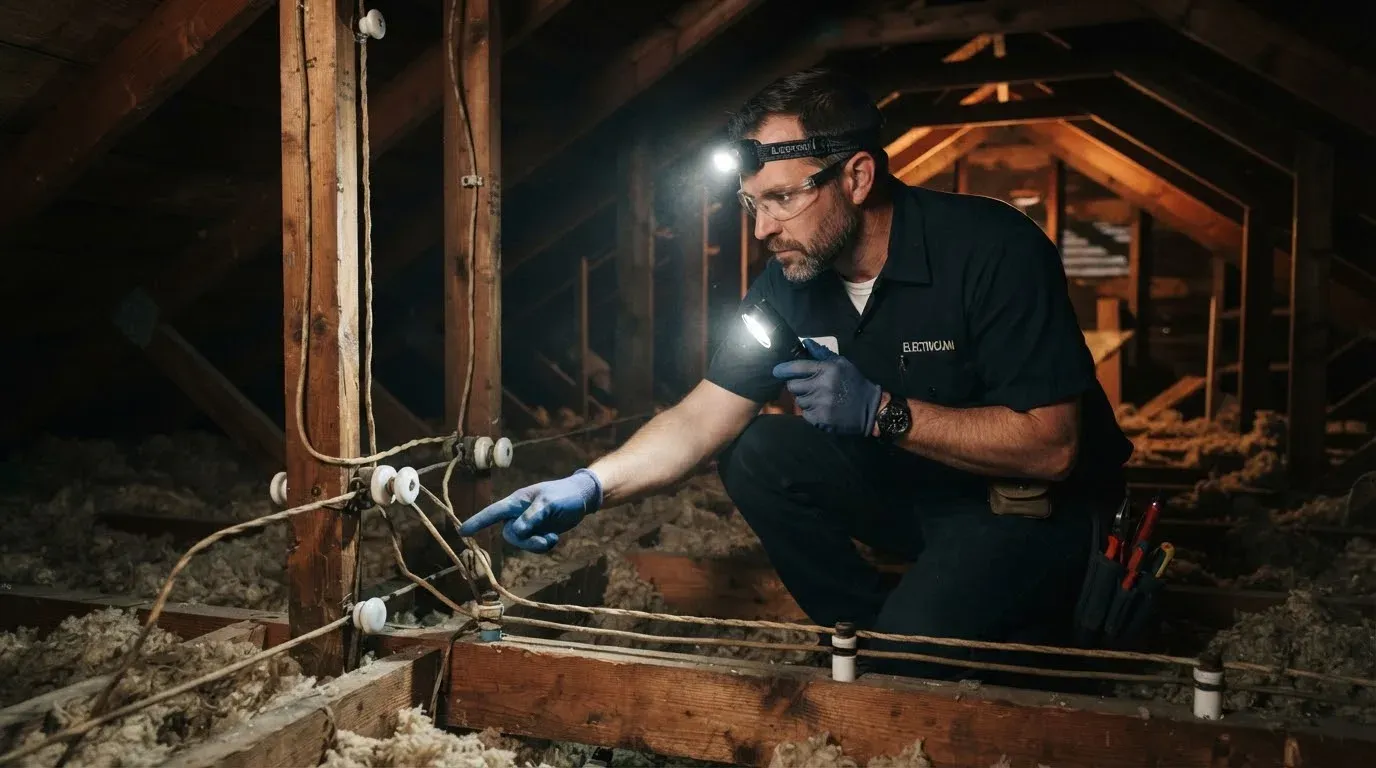
Often, at least in part. Knob-and-tube runs single wires through porcelain knobs and tubes, with the hot and neutral spaced apart and cooled by the air around them. There’s no ground wire.
The insulation on those old wires gets brittle with age, but the bigger problem is what happened later. Many of these houses had insulation blown into the walls and attic decades after they were wired, and knob-and-tube depends on open air to shed heat. The National Electrical Code doesn’t allow knob-and-tube in hollow spaces filled with loose, rolled or foamed-in insulation for exactly that reason.
If you’re buying or insuring a house like this, expect to be asked whether the knob-and-tube is still live or has been abandoned in place. Those are very different situations, and an electrician can tell you which one you have.
What about homes wired from about 1950 into the early 1960s?
Plastic- and cloth-sheathed cable replaced knob-and-tube, but many of these homes still have no equipment ground, and service sizes were small by today’s standards. A 60-amp service was common, which was plenty for a refrigerator, lights and a TV and is not enough for central air, an electric range and a car charger.
The problem to watch for here is the three-prong outlet fitted to a two-wire circuit. It looks right and gives no ground at all. Done properly, those outlets either get a real ground run to them or GFCI protection with the required “no equipment ground” label.
Is a home from 1965 to 1973 likely to have aluminum wiring?
It might. During those years aluminum was used for branch circuits in a lot of homes, according to the U.S. Consumer Product Safety Commission, not just for the large service wires where it’s still standard today.
Aluminum expands and contracts more than copper, and it oxidizes at the connection. Over years of heating and cooling, connections at outlets, switches and splices loosen, and a loose connection under load gets hot. The trouble shows up where aluminum meets a screw terminal or a splice.
It’s fixable without tearing out every wire. Repairs that join a short copper lead to the aluminum at every device and splice, using connectors made for aluminum, are recognized by the CPSC as a permanent repair, and they cost much less than a full rewire. Standard outlets and switches aren’t rated for direct aluminum connection unless they’re marked for it.
What changed for homes built from the mid-1970s through the 1980s?
Grounded copper cable became the norm, and services grew to keep up with air conditioning and electric appliances. GFCI protection started showing up in code for bathrooms in 1975 and garages in 1978, then kitchen counters near the sink in 1987.
These homes are usually sound. The gaps are capacity, if the household has since added central air, electric cooking, a hot tub or an EV, and GFCI coverage that’s much narrower than today’s rules.
How are homes from the 1990s and early 2000s different?
GFCI protection covers most wet and damp locations, and services of 150 to 200 amps became more common. What these homes usually lack is arc-fault (AFCI) protection, which targets arcing at damaged cords and loose connections, a fire risk a GFCI doesn’t address. AFCI requirements started with bedroom circuits around the turn of the century and expanded to most living areas in later code editions.
What about homes built in the last twenty years?
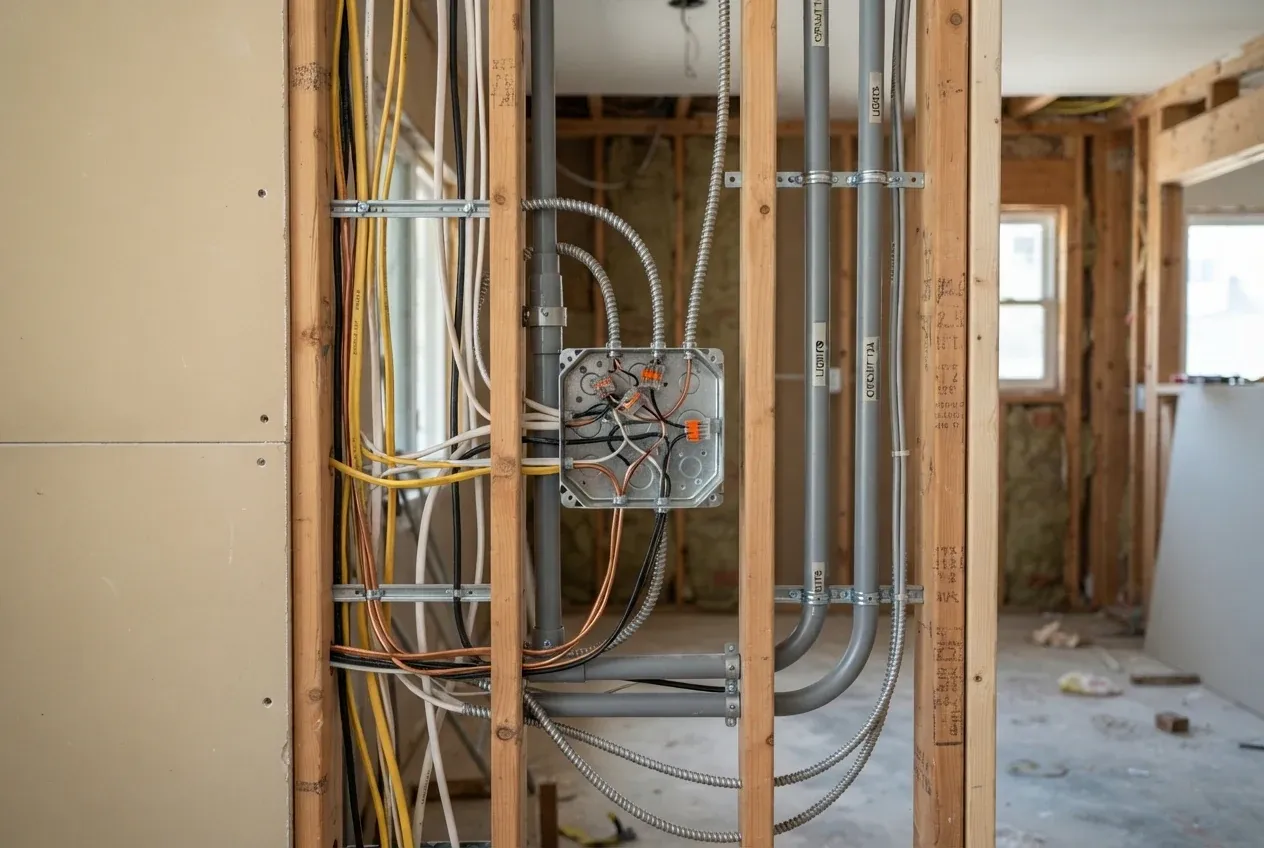
Expect 200-amp service in many of them, AFCI protection across most living spaces and, in the newest homes, some planning for EV charging. The usual issue is capacity for loads nobody planned for when the house was built, such as a second EV, a heat pump or an induction range. Our guide to EV charging on a 100-amp panel explains how that gets worked out.
What should you do about an older home’s wiring?
What’s physically there matters more than the year. A house built in 1968 may have been completely rewired in 1995, and an electrician can see a lot of it from the panel, the accessible junction boxes and a sample of outlets and switches.
Up to code when built isn’t the same as safe today. Codes apply when work is done. A house wired to 1978 standards met the code in 1978 and was never required to keep up, so it isn’t “in violation” now. The useful questions are whether the wiring has deteriorated, whether someone modified it badly, and whether its capacity fits the way you live.
If you’re buying an older home, or you’ve just moved into one, a dedicated electrical inspection goes much further than the electrical part of a general home inspection, which by design is a quick look. When the inspection finds knob-and-tube, aluminum branch circuits or ungrounded runs that need replacing, home rewiring can be done room by room. When the service is the limit, it’s an electrical panel upgrade. Call us with the year the house was built, and we’ll get a licensed electrician out to tell you which of those, if any, your home needs.