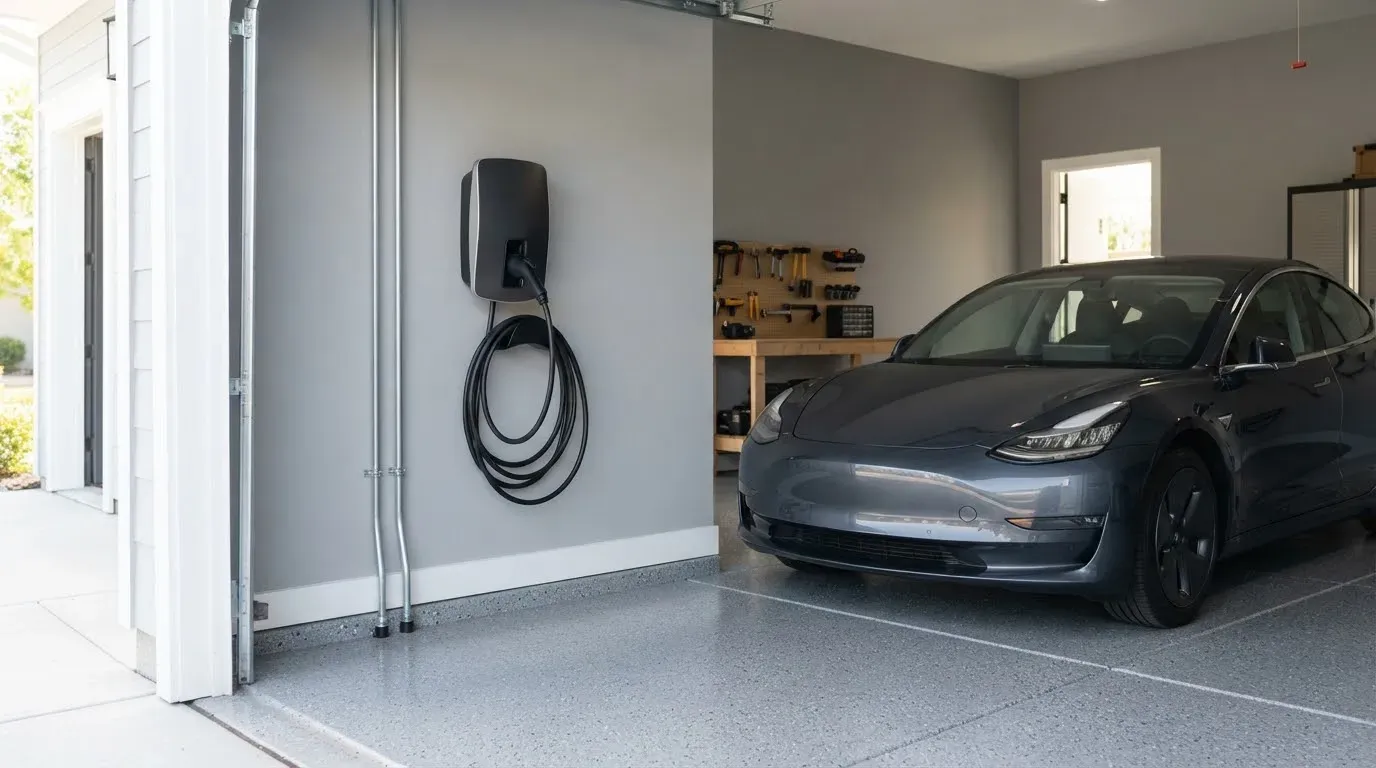
Often, yes. A 100-amp service can run a Level 2 EV charger when a load calculation shows there’s room, usually with the charger set to a lower current or paired with load management that slows charging while the range, dryer or AC is running. When the numbers don’t work even then, the answer is a bigger service.
For an EV charger installation, the panel decides the plan, so it gets looked at before anyone picks a breaker size. Call Hire Local Electrician with the car and the charger you have in mind, and we’ll get a licensed electrician out to run the numbers on your house before you spend money on a panel you might not need.
What size circuit does a Level 2 charger need?
Level 2 chargers run on 240 volts, the same as a dryer or a range. The National Electrical Code treats EV charging as a continuous load, because it can run at full current for hours, so the circuit has to be rated at 125% of what the charger draws. In practice that gives these pairings:
| Charger set to | Breaker and circuit | Power at 240 volts |
|---|---|---|
| 16 amps | 20 amps | about 3.8 kW |
| 24 amps | 30 amps | about 5.8 kW |
| 32 amps | 40 amps | about 7.7 kW |
| 40 amps | 50 amps | about 9.6 kW |
| 48 amps | 60 amps, hardwired | about 11.5 kW |
To put that against a 100-amp service: the whole house can draw roughly 24 kW at 240 volts. A charger at 48 amps would take nearly half of it on its own, for hours at a time. A charger at 24 or 32 amps leaves far more room for everything else.
Most wall chargers let the electrician set the maximum current during installation, with a dial, a switch or the setup app. So a charger rated for 48 amps can be installed at 32 or 24 to fit the panel, and turned up later if the service grows.
Plug-in or hardwired?
A plug-in charger usually goes on a 50-amp circuit with a NEMA 14-50 receptacle and charges at up to 40 amps. Newer code editions require GFCI protection on a 240-volt receptacle in a garage or outdoors, and some chargers trip a GFCI breaker for no obvious reason. A hardwired charger has its own built-in ground-fault protection, avoids that problem, and is the only option above 40 amps.
How do you know if the panel has room?
The electrician does a load calculation. It adds up what the house can demand: square footage, cooking, the dryer, the water heater, heating and cooling, a well pump, a hot tub, any shop equipment. Then the charger goes on top, and the total has to fit inside the service rating.
For an existing home there’s a second route. If the utility can provide twelve months of the home’s actual peak demand, the code allows that real peak, increased by 25%, to stand in for the calculated load. Plenty of homes use less than the paper calculation suggests, but not every utility meter records peak demand, so this isn’t always available.
As a rough guide, homes that heat, cook and make hot water with gas often have room for a modest charger on 100 amps. All-electric homes with electric heat, an electric range and an electric water heater often don’t.
The panel itself matters as much as the math:
- Breaker space. A charger needs a two-pole breaker, which takes two slots. A full panel may need a tandem-rated layout or a subpanel.
- The panel’s age and brand. Some older panels have a poor safety record, and some can’t get replacement breakers anymore. That’s a reason to replace the panel whatever the charger needs.
- Distance to the parking spot. A long run to a detached garage or the far side of the driveway means heavier wire, and that’s often a bigger part of the price than the charger circuit itself.
What is load management, and does it avoid an upgrade?
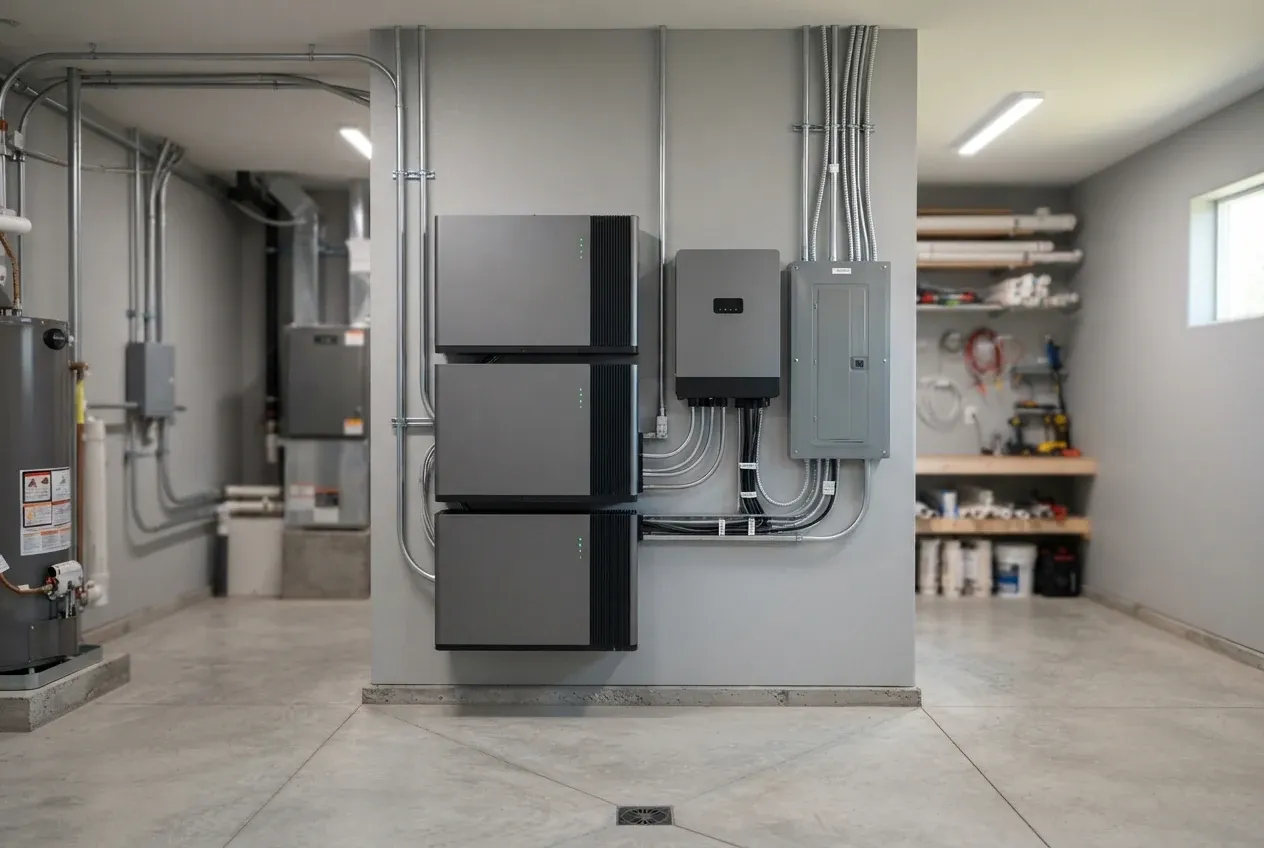
Load management watches how much current the whole house is drawing and turns the charger down, or pauses it, when the house gets close to its limit. Sensors clip around the service wires, and the charger or a separate controller adjusts in seconds. Overnight, when little else is running, the car charges at full speed.
The code recognizes these systems, so the charger can be counted at the level the system allows rather than its full rating, subject to the local inspector. For a lot of 100-amp homes that’s the difference between adding a charger this month and waiting on a service upgrade.
Another approach shares an existing 240-volt circuit, usually the dryer’s, through a listed device that gives the dryer priority and pauses the car while it runs. It suits a home where the dryer sits near the parking spot and the panel has no space at all. The device has to be listed for that use and accepted by the local inspector.
The trade-off is speed. A managed charger on a busy evening may add range slowly. If both cars in the driveway are electric and both need full charges every night, management alone may not be enough.
When does a 100-amp service need an upgrade?
The upgrade comes in when:
- the load calculation doesn’t fit even with the charger turned down or managed
- you’re adding a heat pump, an induction range or a second charger in the same year
- the panel is out of space and can’t take a subpanel
- the panel is a brand or age that should be replaced anyway
Do you need 200 amps? Not automatically. Many homes with modern loads land there, but the calculation decides, and a 125- or 150-amp service is sometimes the better fit. Our electrical panel upgrade page covers what a service change involves. It usually means coordinating with the utility to disconnect and reconnect, and sometimes a heavier service drop, so it takes longer to schedule than a charger circuit.
Do I need a permit for an EV charger?
Usually. A new 240-volt circuit almost always needs an electrical permit and an inspection, and the U.S. Department of Energy notes that many areas want an installation plan approved before the work begins. The electrician pulls the permit. Keep the inspection sign-off, because insurers and buyers may ask for it.
What should I tell you when I call?
A few facts let us get the right electrician out with the right plan:
- the number printed on your main breaker, if you can see it without removing any covers
- whether your heat, water heater, range and dryer are gas or electric
- the charger you have or want, or the maximum current your car accepts
- where you park, and roughly how far that is from the panel
- whether the charger will be inside a garage or mounted outdoors
What’s the next step?
If you already know you’re on 100 amps, don’t buy a new panel first. Call us with the details above, and we’ll get a licensed electrician out to run the load calculation and tell you which route fits: a charger turned down to suit the panel, load management, or a service upgrade. You’ll have a quote for that route before a wire gets pulled. Full details on the work itself are on our EV charger installation page, and if your main breaker has already been tripping, read why breakers keep tripping before adding anything to the panel.