When half the house goes dark and the other half keeps running, the cause is almost never one bad circuit. Most U.S. homes get two 120-volt legs from the utility, which together make 240 volts. Lose one leg, or the neutral that keeps the two balanced, and roughly half the breakers in the panel lose power at once.
That makes a partial outage a service problem, and it can sit on the utility’s wires or in your own meter base and panel. Call Hire Local Electrician, tell us what’s working and what isn’t, and we’ll help you work out which side it’s likely on. When the fault is in your equipment, we’ll get a licensed electrician out to find it.
Why would only half the house lose power?
Breakers in a standard panel alternate between the two legs as you go down the rows. Lose one leg and every other breaker goes dead, which is why the outage looks random: the kitchen is out, the living room works, one bedroom is dark and the next one is fine.
Appliances that run on 240 volts use both legs, so they act strange in a way that’s a useful clue. The central AC, the electric range, the water heater and a well pump may stop. An electric dryer often tumbles but won’t heat, because its motor runs on 120 volts from the leg that’s still live while the heating element needs both.
Is it a lost leg or a lost neutral?
The two failures look different, and the difference matters, because one is an outage and the other can damage everything plugged in.
| What you’re seeing | What it usually points to |
|---|---|
| About half the breakers dead, the rest of the house normal | A lost leg: one hot conductor open at the transformer, the service drop, the meter or the main breaker |
| 240-volt appliances dead or running weakly | A lost leg |
| Lights brighter than usual in some rooms and dimmer in others | A lost or loose neutral |
| Brightness changes when something big switches on | A lost or loose neutral |
| Bulbs burning out, electronics shutting off or failing | Over-voltage from a lost neutral |
| Lights flicker in wind or since a storm | A loose or damaged connection at the service drop or weatherhead |
Why a lost neutral is the dangerous one
The neutral holds each leg close to 120 volts. When it opens, the two halves of the house end up in series across the full 240 volts and split it according to whatever is running. The lightly loaded side can climb well past 120 volts while the heavily loaded side sags. That’s how TVs, computers, chargers and appliance boards get destroyed, and it’s why lights going brighter in one room while they dim in another is urgent even when nothing looks dramatic.
If a single circuit flickers when the AC starts, that’s usually a different and much milder issue. The guide on lights that flicker when the AC kicks on covers it.
Is it the utility’s problem or mine?
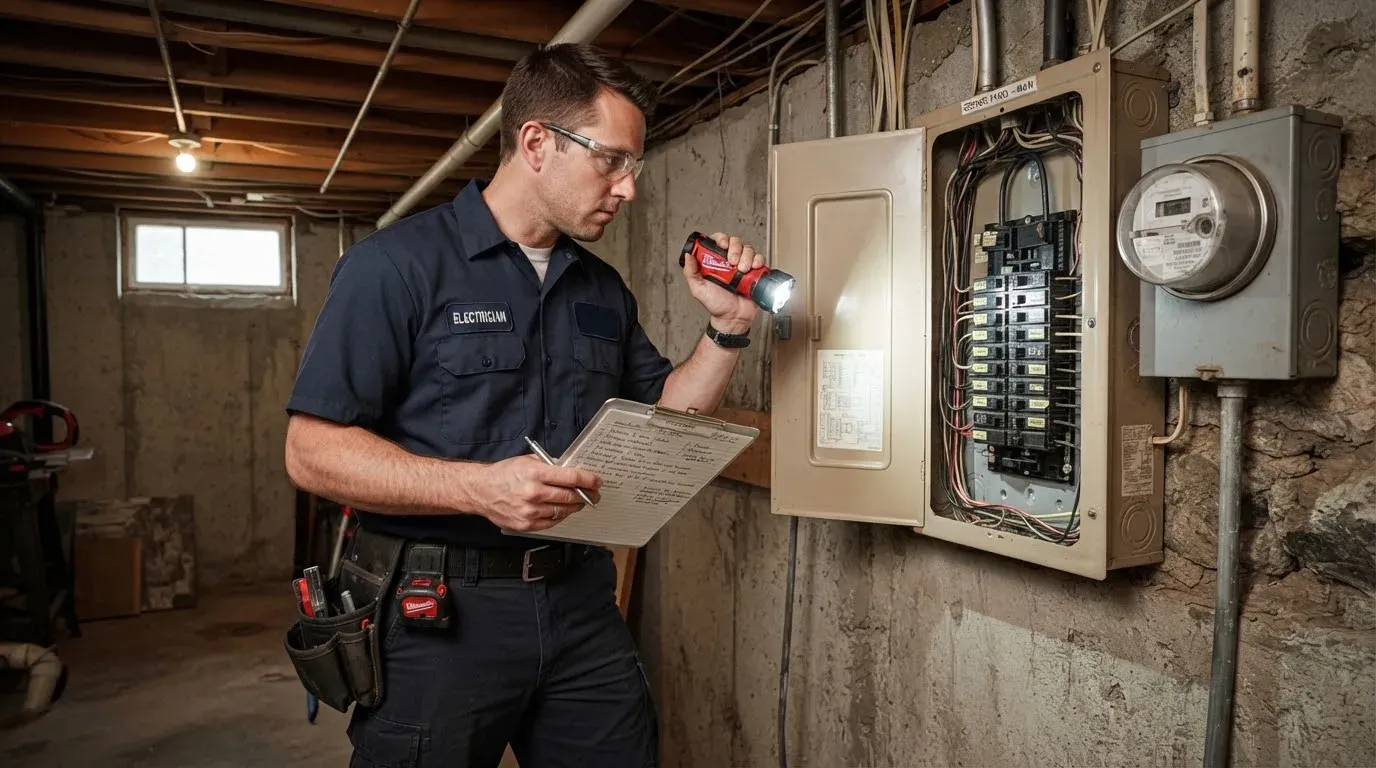
It depends on where the break is. In most areas the utility owns the wires from the transformer to the point where they attach to your house, plus the meter itself. The weatherhead, the service entrance cable down the wall, the meter base and the panel usually belong to the homeowner. Where exactly the line falls varies by utility.
Signs the fault is on the utility side:
- neighbors on the same transformer have the same half-power problem
- the service drop is down, sagging, or has a branch on it
- it started during a storm or right after work on the poles
Signs it’s in your equipment:
- the meter base looks burned, rusted or pulled away from the wall
- the panel cover or main breaker is warm, buzzing or smells hot
- the problem comes and goes and the neighbors have none of it
- one subpanel is dead while the main panel is fine
When the break is on the utility’s wires, the utility repairs it, and nothing in your panel will bring that leg back. When it’s in the meter base, the service entrance or the panel, that’s licensed electrician work, and the utility often has to disconnect the service before the repair and reconnect it after.
Could it be a tripped breaker or GFCI instead?
Sometimes, and it’s worth one look. A tripped breaker kills one circuit, not half the house. But a few things can mimic a partial outage:
- a tripped GFCI that protects outlets in several rooms (our guide on GFCI outlets that won’t reset explains how to find it)
- a tripped two-pole breaker feeding a subpanel, which takes out everything on that subpanel, often an addition, a garage or a basement
- a main breaker that’s failing internally on one pole, which looks exactly like a lost leg
If every breaker shows on and the outage still runs through unrelated rooms, stop resetting things. The fault is upstream of the branch circuits.
What should I do while the power is half out?
- If a service wire is down, stay well away from it and from anything it touches, and call 911.
- If lights are getting brighter or electronics are acting up, switch off the main breaker if the panel is dry and you can reach it safely. Losing all the power is better than over-voltage reaching everything plugged in.
- If you can’t safely reach the main, unplug TVs, computers and other electronics.
- Don’t open the panel cover or touch the meter.
- Don’t plug a generator into a dryer or range outlet to feed the house. Power fed backward through the panel can reach the utility’s lines and the people working on them.
- Call us and describe which rooms are out, what the 240-volt appliances are doing, and whether the lights look normal, dim or too bright.
What does the electrician check?
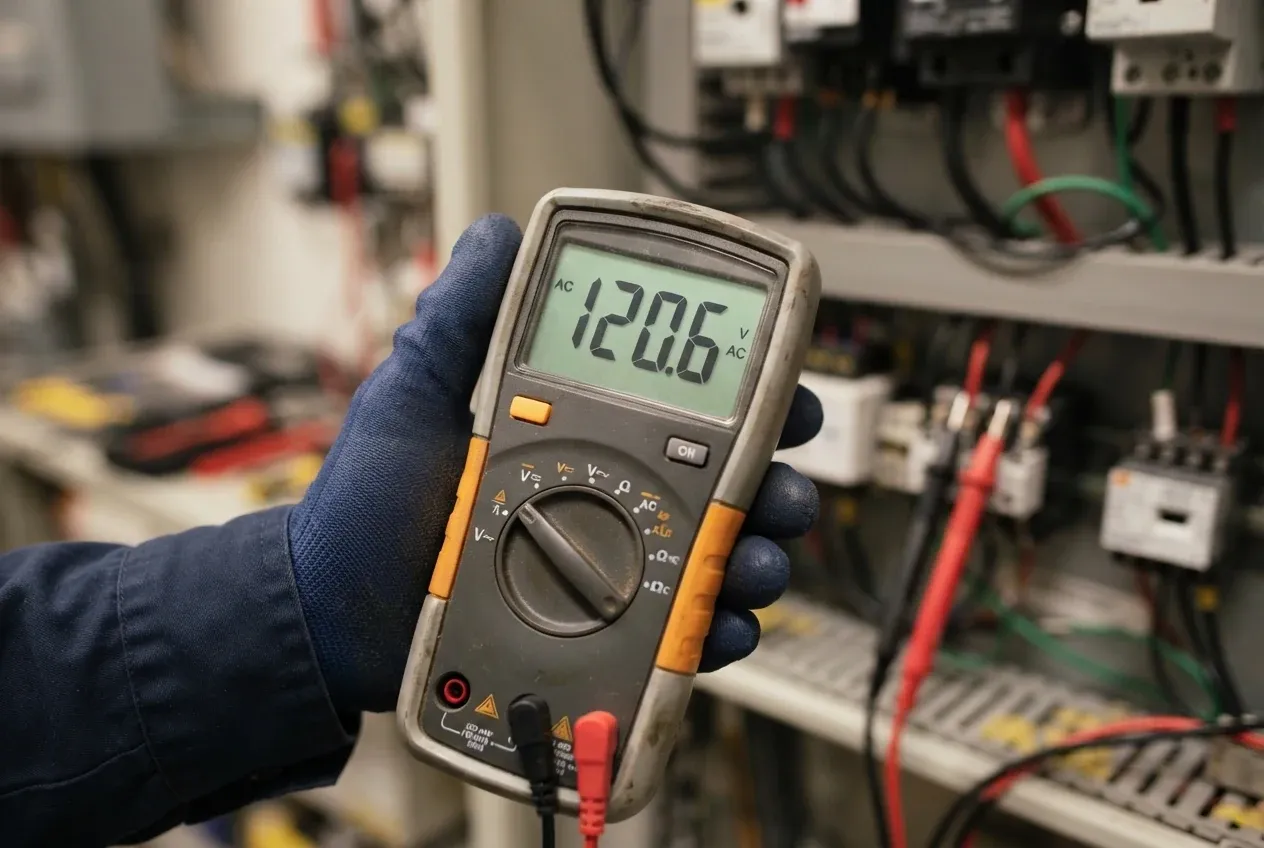
The electrician measures voltage on each leg and between the legs at the main lugs, then compares the readings with and without load. That shows quickly whether power is arriving at the panel properly or getting lost inside it.
From there the work goes to the connections that carry the whole house:
- the main lugs and the neutral bar, checked for looseness and heat damage
- the main breaker, tested on both poles
- the meter socket jaws, which can burn where the meter plugs in
- the service entrance cable and weatherhead for damage or water
Repairs at the meter base or service entrance usually need a permit and an inspection, and in many areas the utility has to sign off before reconnecting. A damaged or overheated panel may be the time to talk about an electrical panel upgrade. For anything with a burning smell, heat at the panel, or lights surging bright, use our emergency electrician service.
Ready to get the whole house back on?
If the neighbors are out too or the line is down, the utility’s side comes first, and we’ll tell you that on the call. If it’s only your house, and especially if lights are going bright and dim, switch off the main if you can do it safely and call us now. We’ll get a licensed electrician out to find where the leg or the neutral is being lost, and you’ll have an estimate for the repair before it starts.